

Dear Gov: A Letter to the Nation Raising Its Children
Nomfundo Nyakane left a corporate career, raised five children without a salary, and turned two years of frustration into a 424-page book — one she nearly couldn't afford to print.
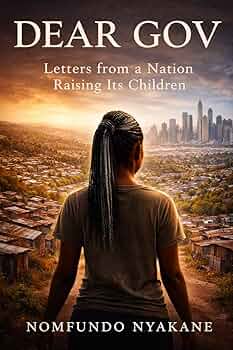
The cover of Dear Gov: a girl from the informal settlements looks out toward Johannesburg, the City of Gold.
Nomfundo Nyakane was a project manager at Huawei Technologies until almost two years ago, when she walked into work, handed in her laptop and quit on the spot. "I'm handing in my laptop. This is my resignation with immediate effect," she told them, and that was that. No notice period, no long goodbye. She was dealing with workplace bullying at the time, a depression severe enough to land her in hospital, and five kids at home — three of her own, plus a niece and nephew she took in after her sister died.
She calls what came after "a good messy." There was no plan. She'd never run anything outside a salary in her entire life — she started working at eighteen and didn't stop until that day. So she started calling herself the unemployed employee, half-joke, half not. The pension savings ran down. Medical aid lapsed. She started taking public transport for the first time in years. Somewhere in all of that she started writing a book.
The book is Dear Gov: Letters from a Nation Raising Its Children, and the title trips people up before they've even opened it. They hear "Dear Government" and assume it's a political book. Nomfundo shuts that down fast, every time someone brings it up. "It is not a political book," she said on air, more than once, the way you do when you've had to correct the same assumption a hundred times. She wrote it as a mother, not a politician. The letters started in 2020 under a different title, Dear Guy, pulled together from open letters other people had written, her own journal entries, conversations that stuck with her. Work and family pulled her away from it for years. What dragged her back this year was watching the president on the news and feeling a disconnect she couldn't shake.
"There's a disconnect," she said. "He's talking from — I don't know what — but there's a disconnect." By then she'd lost the medical aid, the car, all the things that had kept that disconnect invisible to her before. She wasn't writing about it from the outside anymore.
Fifteen letters, and the stories underneath them
The book opens with fifteen letters addressed to government, and after that it breaks into true stories with scripture as page breaks — Proverbs 22:6, James 1:12. Her brother shows up in it, a mining engineer who lost the job and the career to drug addiction and never went back. She writes about being molested as a child. There's an intern she managed who arrived in Johannesburg on a one-way trip from KwaZulu-Natal and told her flatly he wasn't leaving without a job. He got one that same day and was on a bus home, employed, before the sun went down. "That sounds like a Jacob story," Carlett said on air. Nomfundo didn't argue with that.
Then there's Amani. Her granddaughter, four years old, and the reason the book reads the way it does. In December a dog bit through the bridge of Amani's nose and into her jaw. Nomfundo got the call while she was babysitting, met her daughter at the hospital, sat with a child who had a hole in her face. The doctors stitched her up. What's left now is a scar, nothing more — and Nomfundo only understood how close it had come later, after her adopted daughter mentioned a near-identical attack on another four-year-old on the same street that had taken the child's entire face. "That was me realising that was a miracle on its own," she said. "Dear Gov is a book that records stories like hers."
The R41,000 she didn't have
Finishing the manuscript was the easy part. Nomfundo thought, like a lot of first-timers do, that you write the pages and a book just appears. It doesn't. There's formatting, proofreading, typesetting, none of it cheap. A contact pointed her to a self-publishing service. The quote came back at R41,000 — editing, proofreading, formatting, one printed copy.
She didn't have it, so she asked. Friends, family, anyone who could spare a hundred rand or two hundred. Most people had their own fuel and grocery problems and couldn't help. Then a pensioner in her street called her back the following week. "I saw your message. I couldn't respond last week. I saw your message. You're saying 100 rand, 200 rand. I just got paid my pension. Where do I deposit the money?" That deposit, plus a bit more from a sister and a cousin, didn't get anywhere near R41,000. But it told her something — that the book was meant to exist, money or no money.
The conventional publishing route wanted eight or nine months she didn't have — the first letter in the book was racing an election she'd assumed was coming in June. So she taught herself the formatting off YouTube and Google, got the book onto Amazon herself, and eventually found a local printer who could move faster than the industry standard. She names him gratefully on air: Print Doctor. "A man of God," she calls him. He walked her through the rest of it.
What the second edition added
People read the first edition and told her, kindly but pointedly, that something was missing. The part of being South African that doesn't make headlines — the parts that get flattened into one word, xenophobic, racist, too white, too black. So the second edition picked up a new chapter, "Write That in Your Book," built around that gap.
Writing it meant going somewhere she'd only written about before. On the morning of her own book launch, Nomfundo drove out to a squatter camp called Waterworks. Shack against shack, roads too narrow for a car, water tankers queued up while families waited their turn. "Since 1994, this is 2026, and we still have people living under these conditions," she said. She'd already written about hating those tankers — what they represent, the tenders and the corruption sitting behind why they're still necessary thirty-two years later — but seeing the queue in person, on a morning she was meant to be celebrating, left her at her own launch wondering whether she'd actually done these people justice on the page.
Dear Gov becomes Dear Us
The book doesn't end with government. It ends with an epilogue called "Dear Us," and Carlett had Nomfundo read it live on air, the way every author who comes through JustGospel does. It rests on three names: Amani, four years old, the future. Nkanyezi, fifteen, a girl in the book who has to arrive early at school just to get a chair — the present. And Nomfundo herself, carrying what she's seen and learned to live with, the past.
I think about Amani — about the day I ran into a government hospital with her in my arms, not knowing what would happen next. She was only four years old. And yet in that moment, she trusted completely in us, in the system, in something bigger than herself.
I think about Nkanyezi, fifteen years old, trying to find a place in a system that asked her to arrive early just so she could have a chair to sit on. Not because she was late — because there simply was not enough.
And I think about myself, about what I have seen, what I have accepted, and what I have learned to live with. In many ways, I am the past. Nkanyezi is the present. And Amani is the future — already here, growing, watching, trusting, and waiting.
This book begins as Dear Gov. But it does not end there. Because the world they are growing into will not be shaped by government alone. It will be shaped by all of us — by what we accept, what we change, and what we choose to do differently. Dear Gov was a question. Maybe the answer has always been closer than we think. Dear us.
"I'm thinking about a sequel now," Carlett said, off the cuff, the second she finished reading. Nomfundo didn't say no. There's already a third book taking shape behind the second edition — she admitted as much, half-laughing, but she wasn't really joking.
"I'm up to my neck with Christians living in a bubble"
Past a certain point the conversation stopped being about the book at all. Nomfundo doesn't separate her faith from current affairs, and she has very little patience for Christians who do — people who go to church, go home, and stay deliberately uninformed about everything happening around them. Commissions of inquiry. The human cost behind the scandals that make the news. "How can you as a Christian not pray for South Africa if you don't know?" she asked. "The Bible says my people perish because of a lack of knowledge."
Proverbs 22:6 — "Train up a child in the way he should go, even when he is old, he will not depart from it."
Her parenting philosophy comes from the same place. Handing a child Bible verses with no context, she says, is like handing them a gun and no bullets and sending them off to fight — they've got a weapon, sure, but nobody's actually taught them how to use it. Equip them properly. Don't just pray and hope it covers it.
Carlett picked up that thread with her own story — nine months in an orphanage in 1984, near the worst of apartheid, and the conviction that something kept her alive until she found her way back to her parents. Nomfundo knew exactly what she was describing. The world calls it gut feeling. For a child of God, it has a name.
Where to find Dear Gov
Buy it direct from Nomfundo and she'll deliver anywhere in the country — that's the cheaper route, at R299. It's also on Takealot at R460, and on Amazon. 424 pages, scripture between every chapter, every story in it true.
Dear Gov
Connect with Nomfundo
Facebook: Nwomfundo Nyakani
Podcast: Surely Podcast SA on YouTube
Direct orders and nationwide delivery available by inbox.